
Crawford County Court Records After a Jail Arrest
After a Crawford County arrest, local custody starts at the Crawford County Jail / Crawford County Corrections Center in Grayling, operated by the Crawford County Sheriff's Office under Sheriff Ryan Swope. The court-record side starts when the arrest moves into the 46th Circuit Trial Court structure and the prosecutor authorizes charges. The Crawford County criminal-matters page explains that criminal cases for crimes committed within the trial court's jurisdiction begin in the District Division or Family Division depending on the defendant's age. Magistrates may issue arrest and search warrants, conduct arraignments, set bonds, and remand defendants to the county jail.
A jail record and a court record answer different questions. Jail inmate records are used for current custody, booking confirmation, bond status, release status, and whether someone has moved to another custody system. Jail roster mugshots are a separate booking-photo issue, and Crawford County did not publish a public mugshot gallery in the sources reviewed. Court records after an arrest focus on the filed criminal case: court, case number, charge list, hearings, bond orders, preliminary examination, plea, dismissal, conviction, sentence, or other disposition.
How to Find Crawford County Court Records After an Arrest
Crawford County court materials point users to Michigan Case Search and the 46th Circuit Trial Court's Crawford County page. The official county courts page links to court resources, while the 46th Circuit site links to Crawford Circuit Court public case search, Probate public case search, and 87C District Court case search. MiCOURT is the main statewide public case-search portal for participating Michigan courts, but official copies and older or restricted records still require clerk contact.
- Start with the Crawford County courts page at crawfordco.org/offices-departments/courts/ or the 46th Circuit Crawford page at circuit46.org/crawford-county-courts/.
- Use the MiCOURT route for the correct court, such as Crawford Circuit Court or 87C District Court, then search by party name or case number when available.
- Open the public case result and read the charge list, hearing history, bond entries, and disposition fields rather than relying only on a booking allegation.
- Contact the clerk if the online result is missing, appears incomplete, or an official copy is needed for court, employment, licensing, or legal use.
The Circuit Court Clerk is listed on the county courts page with the circuit clerk phone at 989-344-3206. District Court is listed separately at (989) 344-3242, with district clerk hearing instructions using 989-344-3240. Michigan State Police ICHAT is a different product for statewide criminal-history searches, and the research notes that ICHAT is not a warrant search and excludes categories such as suppressed records, federal records, tribal records, juvenile records, and some local matters.
The Michigan MiCOURT portal is shown in the state case-search screenshot from micourt.courts.michigan.gov/case-search/.
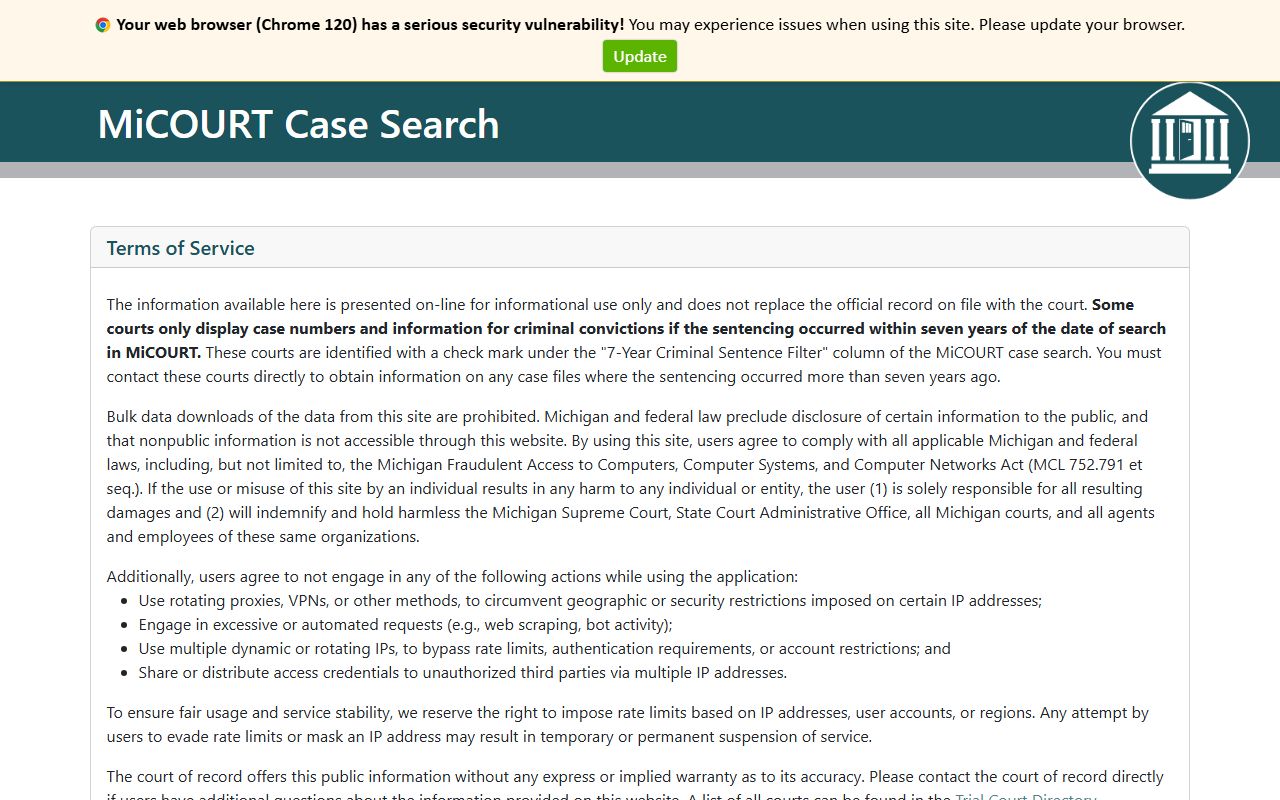
That portal is useful after a case has opened, but it does not replace the Crawford County Jail phone for same-day custody confirmation.
| Search Channel | Best Use | Limits |
|---|---|---|
| MiCOURT statewide case search | Public case lookup by court, party name, or case number where available. | Dynamic portal and court-publication limits may affect what appears. |
| 46th Circuit Crawford page | Links to Crawford Circuit, Probate, and 87C District Court case-search routes. | Use clerk contact for official copies or unclear docket entries. |
| Crawford County courts page | Local contacts, judge and clerk listings, hearing access notes, and MiCOURT links. | Not a jail roster and not a statewide criminal-history report. |
| Michigan State Police ICHAT | Name-based statewide criminal-history path through MSP. | Not for warrants, federal custody, tribal cases, juvenile records, or local jail custody. |
How Charges Get Filed After an Arrest: Complaint, Information, and Indictment
The charge record after a Crawford County arrest does not always match the words used at booking. The jail may record the arrest or warrant basis when a person is lodged. The prosecuting attorney then reviews the matter and decides what to authorize. The Crawford County Prosecuting Attorney's Office says it reviews, authorizes, and prosecutes felony and misdemeanor violations of Michigan law and county ordinances committed in the county. That authorization decision turns arrest allegations into filed court charges.
Michigan criminal cases commonly use a complaint at the beginning of a case. A felony case may later involve an information after the district-court stage, especially after bindover to circuit court. Indictments are less common in day-to-day county practice but remain a formal charging route for serious cases. MiCOURT and clerk records should be read with those stages in mind because a case can begin in District Court, then move to Circuit Court if the charge is bound over.
| Document | Filed By | Common Use | What to Check |
|---|---|---|---|
| Complaint | Officer or prosecutor, depending on the case stage and court practice. | Often starts a misdemeanor or felony case and supports warrant or arraignment activity. | Name, date, charge language, offense date, warrant reference, and court number. |
| Information | Prosecutor. | Common felony charging document after a case proceeds beyond the district-court probable-cause stage. | Whether charges changed after preliminary examination or bindover. |
| Indictment | Grand jury process. | Serious or specially handled criminal matters. | Filed counts, offense levels, and whether the case bypassed the usual complaint path. |
Charge Status and What It Means
Charges can change between jail booking, arraignment, preliminary examination, plea negotiations, trial, and sentencing. Crawford County research specifically warns that booking charges can differ from the charges the prosecutor files. A charge can be amended, reduced, added, dismissed, bound over from District Court to Circuit Court, or resolved by a plea or trial verdict. Read each charge line separately rather than treating the first visible charge as the final outcome.
| Status | What It Means | Practical Reading Tip |
|---|---|---|
| Pending | The charge has not reached final disposition. | Check the next hearing date, bond order, and whether the court is District or Circuit. |
| Amended or Reduced | The prosecutor or court record shows a changed charge, level, or count. | Compare the original complaint with the later docket entry or information. |
| Dismissed | The charge was ended without a conviction on that count. | Look for whether other counts remain active or were resolved separately. |
| Bound Over | A felony case moved from District Court toward Circuit Court after the probable-cause stage. | Search both district and circuit records if the case seems to split across courts. |
| Convicted | The charge resulted in a guilty plea, no-contest plea, or guilty verdict. | Review the sentence, jail credit, probation terms, and appeal entries if present. |
Bond and Release After an Arrest
The Crawford County Criminal Matters page explains that at arraignment the court tells the defendant the specific charges, advises rights, addresses appointed counsel if needed, and decides bond eligibility and amount. For a felony arrest, the page says arraignment normally follows the day after arrest and that the preliminary examination date is set within 14 calendar days after arraignment. If bond is posted, release is tied to appearing at the next required court date. If bond is not available or cannot be posted, the person remains in the county jail until further court action.
Bond posting is local and time-sensitive. The court materials say bonds can be posted at the clerk's office during regular court business hours, while after-hours bonds go through the county jail. The traffic page adds a misdemeanor traffic example: a person arrested on a traffic misdemeanor is taken to the county jail, processed, and allowed to post bond; if bond is not posted, the person spends the night in jail. Payment methods and jail bond fees were not published in the reviewed sources, so payment should be confirmed before traveling.
| Bond Type | How It Works | Local Caveat |
|---|---|---|
| Cash Bond | Money is posted to secure release and future appearance. | Money can be forfeited if the defendant misses a required court date. |
| Surety Bond | A surety or bond agent backs the release where allowed. | Crawford County did not publish a local bondsman process in the reviewed pages. |
| Personal Recognizance | Release is based on a promise to appear and comply with conditions. | Eligibility is handled at arraignment or by later court order. |
| No-Bond Hold | Release is not available until a judge or holding agency changes the custody status. | Another warrant, detainer, parole/probation hold, ICE hold, or outside-county hold can affect release. |
Warrants That Lead to an Arrest
No official Crawford County active-warrant search database was located in the research. The county site defines a warrant as a judge's order allowing police to arrest a person, and a bench warrant as an order from the court requiring arrest so the person can be brought before the court. The Criminal Matters page says magistrates can issue arrest and search warrants, conduct arraignments, set bonds, and remand defendants to the county jail.
For warrant questions, use the court and jail channels based on the status of the matter. If the question is whether a person has already been booked on a warrant, call the Crawford County Jail. If the question is whether a public case shows a failure to appear, hearing, or warrant-related entry, search MiCOURT and contact the relevant clerk. If a public copy of warrant-related records is needed and the record is not online, use the Crawford County FOIA process, recognizing that law-enforcement exemptions may apply.
Charges vs. Convictions
An arrest or filed charge is not a conviction. Court records after a jail arrest should be read by stage: booking allegation, prosecutor filing, arraignment, hearings, plea or trial, and disposition. A person can be arrested and charged, then have one count dismissed, another count amended, or the entire case resolved without a conviction. The conviction line matters because it reflects a plea or verdict, not merely an accusation.
| Charge | Conviction | |
|---|---|---|
| Stage | An accusation filed or carried in the court case. | A final outcome after plea, no-contest plea, or verdict. |
| Proof Level | Probable cause or charging authorization may support the case moving forward. | The criminal burden is proof beyond a reasonable doubt, or a valid plea accepted by the court. |
| Record Meaning | Shows what the prosecutor alleged or amended. | Shows the offense the person was found guilty of or admitted. |
| Lookup Caution | May appear before all facts, motions, or negotiations are complete. | Should be checked with sentence, discharge, set-aside, and appeal entries if relevant. |
Sealed vs. Expunged Arrest Records
Michigan uses set-aside and restricted-access concepts rather than a simple one-word removal rule for every case. MCL 780.621 is the Michigan set-aside statute referenced in the research. If a conviction is set aside, public access can change, but the effect depends on the order, the record type, and the agency holding the record. A dismissed or sealed court record may still require careful follow-up with the clerk, the arresting agency, MSP criminal-history records, and any third party that copied older information.
| Sealed or Restricted | Set Aside or Expunged | |
|---|---|---|
| Public Visibility | Hidden or limited from ordinary public access by court rule, statute, or order. | Public conviction access may be removed or restricted after a successful set-aside process. |
| Record Location | The record may still exist with the court or justice agencies. | The record may still be retained for limited law-enforcement or statutory purposes. |
| Eligibility | Depends on case type, age, juvenile status, order, and public-record limits. | Depends on Michigan law, waiting periods, offense type, prior record, and court order. |
| Best Verification | Ask the clerk what access is available and whether an order restricts the file. | Use the final court order and verify with MSP or the originating court when needed. |
Criminal History vs. Court Records
Court records show the case filed in a court. Criminal-history reports, such as Michigan State Police ICHAT, are different. ICHAT is a statewide criminal-history access channel, but the research notes exclusions for suppressed records, warrants, federal records, tribal records, traffic records, juvenile records, some local misdemeanors, and out-of-state records. MDOC OTIS is different again: it covers people under Michigan Department of Corrections jurisdiction or recent supervision history, not county jail prisoners who were arrested yesterday.
Important: Do not use jail, court, or custody summaries for credit, employment, tenant screening, insurance, or any other FCRA-covered decision.
Restricted Court Records After an Arrest in Crawford County
Not every record connected to an arrest is fully public online. Juvenile matters, sealed cases, suppressed records, ongoing investigations, victim information, medical or mental-health information, and law-enforcement-sensitive material may be withheld or limited. Michigan FOIA gives a right to inspect or receive copies of public records from a public body subject to exemptions, and Crawford County's FOIA summary says requests should describe the records clearly enough for the county to find them.
For jail or arrest records that are not in MiCOURT, the research points to the county FOIA route: Crawford County FOIA Coordinator, 200 W. Michigan Ave., Grayling, MI 49738; fax (989) 348-5743; email FOIA@crawfordco.org. Include the person's full name, booking or arrest date, arresting agency if known, case number if known, and the exact record requested. The county summary states a five-business-day response period with one possible 10-business-day extension, and fees or deposits may apply.